
OCP, Texas
I. M. Pei built Dallas City Hall to mean open government. RoboCop made it a fortress, and the world fell for it.

A Celebrity at the Grocery Store
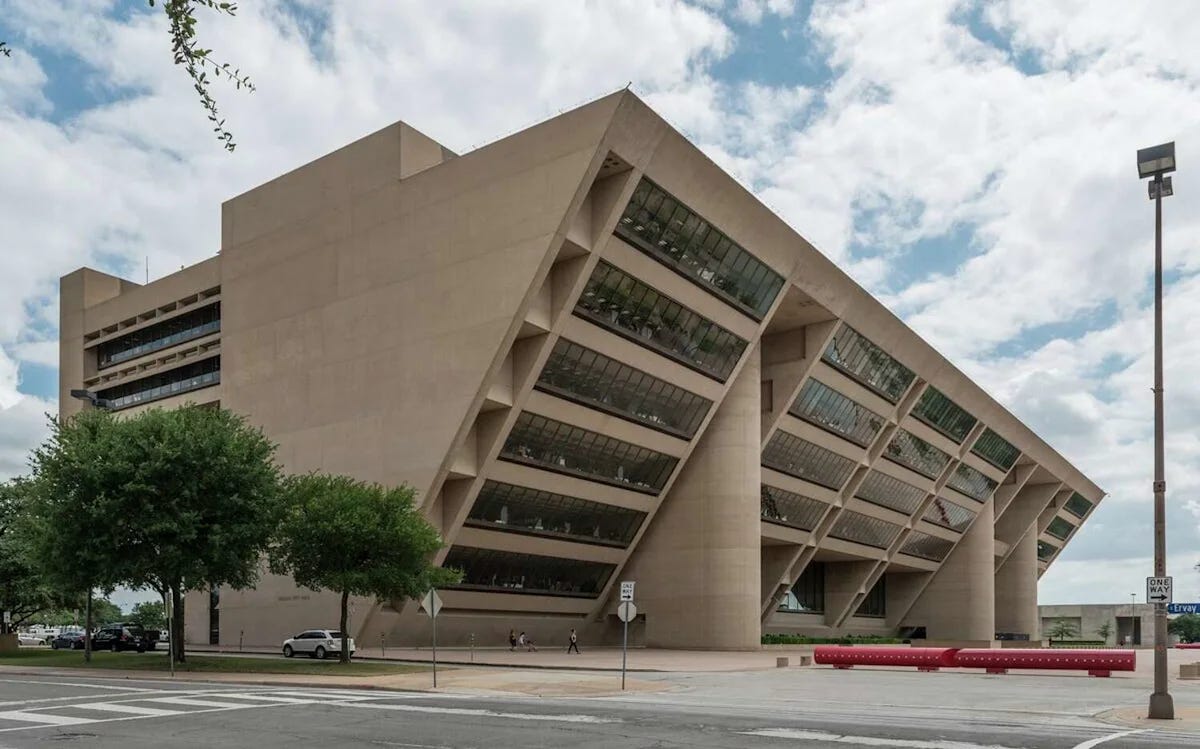
The first time I saw Dallas City Hall in person, I had the disorienting sense of running into a celebrity at the grocery store. I had known the facade and profile for years, thanks to the visual intimacy of a cult film watched far too many times. I just hadn’t known it was real, or that it had a day job, or that the day job was running a major American city.
What I knew all too well was the movie. I’m a Llano man—I grew up out on the Caprock, where the tallest things around are grain elevators and windmills and the sky does most of the talking—and I came to Dallas in the summer of 2001 the way a lot of people come to Dallas: for work, with no particular feelings about the place that were not sourced in the prefab mythos of DALLAS. So when I rounded a downtown corner one afternoon and found myself staring up at the headquarters of Omni Consumer Products — the megacorporation that privatizes the police and manufactures the killer robots in Paul Verhoeven’s RoboCop1 — my first thought was not: what a building! It was: what is that doing here?
There is a name for the vertigo of meeting the real version of a thing you have only ever known on a screen. Jean Baudrillard called it the precession of simulacra: the copy arrives ahead of the original and then outranks it, until the map feels truer than the territory it was originally traced from. Umberto Eco, too, went hunting the same sensation across America in Travels in Hyperreality, among the waxworks and theme-park replicas engineered to feel more convincing than the real thing. But back then, I had none of that vocabulary on the sidewalk that afternoon. I had the symptom. The mind files the thing under fiction and the body refuses the correction, the way you can shake hands with the actor who played the murderer and feel, for half a second, that you ought to leave. I waited for the building to stop being OCP and start being a city hall, and it flatly declined. Some twenty years on, it has still not entirely complied. The movie got there first in my head, and first is hard to beat.
Out in the world, the order was reversed. The building got there first by nearly a decade. It is a working seat of municipal government, finished in 1978, designed by I. M. Pei — one of the most celebrated architects of the century, and the man who would later famously set the glass pyramid in the courtyard of the Louvre. RoboCop did not build this Brutalist slab. It borrowed it for 102 minutes and declined to give it back. What it did in that borrowed time would come to outweigh everything the city intended, which is why Dallas is now arguing over whether the building deserves to stand at all.
The Outsider They Kept Trusting
The man who drew it had crossed an ocean by steamship and spent his first American years learning the particular wariness of the outsider. Ieoh Ming Pei was born in Canton in 1917, the son of a banker, and came to the United States in 1935 to study, first at MIT and then at Harvard, where the émigré Walter Gropius schooled him in the severe modern grammar he would spend a career bending back toward grace. He was seventeen when he sailed. Imagine: a Chinese teenager landing in a country that had literally written the exclusion of the Chinese into its federal law and would not fully repeal it for another decade. He stayed anyway. And he rose, by the way.
Consider what the rise amounted to. Washington handed him the East Building of its National Gallery. Paris handed him the courtyard of the Louvre and let him drop a glass pyramid in front of an eight-hundred-year-old palace, to a chorus of outrage that has since curdled, as outrage often does, into love. Hong Kong let him redraw its skyline. The man who began as the least at-home person in any American room became the one nations summoned when they wanted a building to look most like themselves. Dallas, improbably, got in line.
A City That Wanted a New Face
It got in line because Dallas, in those years, was desperate to be taken seriously, and anyone who has spent time in Texas knows the particular flavor of that hunger. The city had grown rich and fast on cotton and oil and gas and banking, a metropolis conjured out of flat prairie in two generations, and it carried the boomtown’s lifelong worry that the rest of the country was laughing at its hefty expense. Cities carry status anxiety the way people do, and Dallas lugged it the way only new money can — the specific dread of the self-made nouveau riche who suspects that everyone at the older, better party can still read the price tags and see where the basting stitches still remain intact on the blazer of the first-time owner. The worry hardened into a wound in November of 1963, when Dallas became, in the national imagination, perhaps forever, the place where a president had been all too publicly assassinated. The city desperately wanted to strike through the mask and reveal a new face to the world.
The man who set out to give it one was J. Erik Jonsson, a founder of Texas Instruments who became mayor in the aftermath and governed like an engineer handed a broken machine. He moved quickly to launch a civic program he called Goals for Dallas, a deliberate and almost touchingly earnest plan to redesign the city into something modern, intentional, and impossible to dismiss. A new city hall would be the centerpiece, the room where Dallas would govern itself in full view of a watching nation. For a centerpiece, you do not call the firm down the street. You call I. M. Pei.
A Building That Leans In to Listen
Pei designed the building to mean the exact reverse of what it means now. He made the south face lean. The upper floors step outward as they climb, each reaching a little farther than the one below, until the whole seven-story mass tilts forward over the plaza like a great concrete brow. It is an upside-down pyramid of government, bending down toward the citizen at its foot. Pei wanted the largest, heaviest object in the civic center to look as though it were leaning in to listen, and he said so plainly: the design was meant to express openness, accessibility, a government inclined toward its people. He chose to say it in raw board-formed concrete, the material of bunkers and overpasses, and asked that brutal stuff to perform considerable acts of tenderness.
The plaza below the brow was the other half of the gesture, a wide apron of pale stone where the citizens the building bowed toward were meant to gather. And they do, though the plaza makes them earn it. In July it is a popping griddle. The sun beats down on the concrete and the concrete throws it back up at you and the building’s broad shadow grants no mercy; the heat waits to great you even in the shade. People cross it fast in summer, squinting behind dark lenses, the soles of their shoes ticking against stone that has been steadily baking since dawn, preheated by the previous day’s blast furnace. Still they come, because it is the front porch of the city. They gather there to celebrate and to mourn and to shout and to protest, and above all, to be heard. They march across it and chant on its steps and press their grievances against the doors of the government Pei tilted toward them, and they have done it since the building opened, and even to this day. The civic embrace was no metaphor that died on the drawings. Whatever else became of this building, the plaza kept its promise.
The building itself was a harder thing to love. It had taken the better part of a decade to raise and had blown through budget after budget, and when it opened in 1978, a fair number of Dallasites looked up at the great inverted slab and saw a fortune they had not meant to spend on a shape they could not read. Severe, they said. Forbidding. Foreign to everything around it. They had been promised a monument to their city’s arrival and had instead been handed a riddle, and the riddle sat at the heart of downtown for nine years, refusing to explain itself, until a Dutchman with a camera arrived and explained it for them. The explanation was not the one they had paid for.
The Dutchman’s Angle
Paul Verhoeven read the same lean as a looming threat.
He came by it honestly, at least. Verhoeven spent his boyhood under the German occupation of the Netherlands, watching real authoritarian power requisition a city, and he arrived in Hollywood with a connoisseur’s eye for how power looks once it stops pretending to be kind. RoboCop, his American debut, is a blood-soaked satire set in a near-future Detroit left to rot, where the police have been sold off to a conglomerate called Omni Consumer Products and the conglomerate means to bulldoze the old city and raise a gleaming Delta City over its bones.2 OCP needed a seat of power, a place from which men in servicable suits could run a dying metropolis like a holding company and roll out the enforcement machines meant to patrol it. Inside that tower,3 in the film, sits the boardroom where an ED-209 droid malfunctions and empties its guns into a sycophantic junior executive while the meeting carries on after this latest “glitch.” Verhoeven needed a building that could hold all of it — the grandeur, the menace, the cold corporate appetite — and he found it in a Texas monument to open democratic government.
A motion-picture camera is a machine for assigning meaning, and it never asks the architect’s permission. Tilt it up at Pei’s cantilever from the right angle, in the right hard light, under the right ominous score (thank you, Basil Poledouris), and the embrace becomes a seething menace. The forward lean stops bowing toward you and starts looming over you. The concrete that was meant to read as candor reads instead as a fortress with something to hide. Verhoeven did not change a brick. He changed the angle, gave it verticality, and the moving images did the rest.
I have spent a good part of my working life on this exact phenomenon. I call it visual determinism: the way a moving image, once it fastens onto a place or a face, can fix that thing’s meaning in the public mind more firmly than any quantity of fact or intention.4 The image arrives, the image repeats, and the image wins. It does not argue with you. It does not have to. It simply shows you the building as a fortress often enough — low, tight, scored for dread — that the fortress is what you go on seeing forever after, even while standing on the sidewalk in plain daylight, watching ordinary people walk inside to pay their water bills. Pei had decades of intention and a whole vocabulary of openness on his side. Verhoeven had 102 minutes and the right lens. The lens won, as it usually does.
Thanks for reading Storywork. If you have ever looked at a real building and seen a movie, you are in the right place.
The Pilgrims of OCP
You would expect the building’s lovers to resent all this. Mostly, they feast on it. The people who love RoboCop love this building, and they love it precisely as OCP, the villain’s stronghold. They drive downtown, on purpose, to stand on the spot where the camera stood and photograph the very lean Verhoeven turned sinister, half hoping ED-209 will clank around the corner, growl, and give them twenty seconds to comply. They know this place as OCP the way other people know a London crosswalk as an album cover, and they love it with the same uncomplicated joy. It is a particular kind of devotee who will arrange a day around a fictional address, and the type is more numerous than the tasteful like to admit. The media scholar Nick Couldry has a name for the trip they make: “the media pilgrimage,” the journey to an ordinary place that fiction has made sacred. Dallas City Hall is a station on that route now, and to its pilgrims the working city hall of the ninth-largest city in America is a shrine, consecrated by the role it played in a film rather than the government it holds.
There is something almost tender in it. Verhoeven recast the building as the face of everything RoboCop loathes — the privatized, weaponized, profit-mad future — and the film’s own fans took that face and pinned it up like a poster over the bed. The insult became a valentine, of sorts. The takeover handed the building a second life it never requested, a devotion its architect would not recognize and might not entirely welcome, and a fame that has outlasted every civic intention Dallas ever poured into the concrete. Ask a stranger to picture Dallas City Hall and, odds are, they will picture OCP. The villain’s version is the famous version. For most of the world, the villain’s version is the only version that matters.
The Election No One Knew They Were Voting In
A building, like a poem or a painting, does not get to decide what it means to other people. We are sentimental about authorship, imagining that intention travels intact from maker to world, arriving unwrinkled. It never does. The presumed authors — the architect, the city that paid the bill, the bronze plaque by the door reciting good intentions — are often the last people consulted. The real author of a place is everyone who ever looks at it, over years, casting ballots in an election no one announced. Pei voted for openness. Verhoeven voted for menace. Then forty years of moviegoers cast the deciding vote, went with the villain, and promptly fell in love with him. A building belongs, in the end, to whoever looks at it longest.
Dallas City Hall has a great deal of company in this. The Brutalist civic building — raw concrete, hard geometry, no apology — became Hollywood’s favorite shorthand for institutional menace: the courthouse you dread entering, the agency that watches you, the future that curdled. Central casting kept calling, and the Brutalist building kept showing up to play the heavy, like a character actor who can only get hired as the warden. A whole movement, raised in the 1960s and ‘70s to embody a confident democratic seriousness, spent the next half-century typecast. Concrete poured to say we have nothing to hide was taught, one film at a time, to say be afraid.
The moving image works on us differently from the page. A novel asks you to build the picture yourself, so the picture stays partly yours. A film hands you the picture finished, lit, scored, and framed, and asks only that you receive it — which you do, again and again, until the received picture hardens into something that feels like memory. Repetition is the whole engine. Nobody ever sat down and decided that Brutalism meant tyranny. We were shown it, enough times, in the dark, and we believed our eyes.
On Loan
Now Dallas is deciding what to do with the building. There is talk of tearing it down and talk of saving it, and the talk runs hot the way civic talk runs hot when it is really about something larger than concrete. Some people see a maintenance sink and an eyesore. Some see a Pei original and a piece of the city’s soul. Some, I suspect, see OCP and cannot quite say whether that is a reason to keep it or a reason to be rid of it. I have a scholar’s interest in that argument and a relative newcomer’s reticence about it, and I am going to leave the verdict exactly where it belongs: with the people who live under this government and pay to keep its lights on. They are the ones who should decide.
It was only ever on loan to the architect, too, because that is how meaning works. You can build a thing to say one perfect sentence, pour your entire intention into the concrete, and the world will still arrive and decide for itself what it sees. Sometimes the world is cruel about it. Sometimes, as the pilgrims of OCP keep proving, it is a strange and unaccountable kind of love. Either way, the building gets no say. It stands there leaning as ever out over its sizzling plaza, meaning whatever we have most recently decided it means, interested only, now, in how long it will be permitted to stand.
The next time you see it — on a screen, or, if you are unlucky enough, in the merciless Dallas sun — notice which version your eye reaches for first. That flinch of recognition is the whole story.
Thanks for reading Storywork. This post is public, so send it to someone who has never looked at Dallas City Hall the same way since 1987.
Works Cited
Baudrillard, Jean. Simulacra and Simulation. Translated by Sheila Faria Glaser, U of Michigan P, 1994.
Calder, Barnabas. Raw Concrete: The Beauty of Brutalism. William Heinemann, 2016.
Couldry, Nick. The Place of Media Power: Pilgrims and Witnesses of the Media Age. Routledge, 2000.
Eco, Umberto. Travels in Hyperreality. Translated by William Weaver, Harcourt Brace Jovanovich, 1986.
González, Christopher. Galactic Herencia: Latinos in the Star Wars Universe. U of Arizona P, forthcoming.
RoboCop. Directed by Paul Verhoeven, Orion Pictures, 1987.
Wiseman, Carter. I. M. Pei: A Profile in American Architecture. Harry N. Abrams, 1990.
Lest you doubt the significance of Verhoven’s masterpiece, it is a part of the Criterion Collection, whose mission “has been dedicated to publishing important classic and contemporary films from around the world.”
RoboCop is set in Detroit, a city the film spends its runtime mourning and bulldozing, yet OCP headquarters is pure Dallas. A Texas civic monument spends the whole movie playing corporate overlord to a dying Michigan metropolis. The building emigrated, in a sense, the way its architect once did.
To the chagrin of locals who admire the building, Verhoven had his special effects artists extend Pei’s design vertically.
I coin the term visual determinism in Galactic Herencia: Latinos in the Star Wars Universe (University of Arizona Press, forthcoming), where it does more careful and more heavily footnoted work than it does here. This is the cocktail-napkin version.